Tell us about the job
Takes about a minute. No obligation.
Before a contractor can say what failed in a water heater here, they have to account for what the system has been running against. 174 severe weather events were recorded in Marathon County, Wisconsin between 2015 and 2024. At that rate, severe weather is part of the normal operating environment for equipment in this county, not an occasional outlier. A unit that shows signs of wear on its pressure relief valve or heat exchanger may be showing exactly what sustained environmental stress produces. That changes what a contractor checks first and which parts they expect to find degraded before the system ever threw a fault.
Parts availability is what shapes the repair bill on an older water heater more than the diagnosis does. Half the homes in Marathon County, Wisconsin were built in 1978 or earlier (2020-2024 ACS 5-year). A contractor who opens a unit installed into stock that age may find the heating element, the thermostat, or the gas valve is a specification that manufacturers have since revised or dropped entirely. When that happens, the scope of the job shifts from a straightforward part swap to a search, a substitution, or a conversation about what the repair is actually worth against replacement. That calculus is what the homeowner is deciding, and it is driven by what the opened unit turns out to contain.
The Parts of a Water Heater a Contractor Checks During a Repair
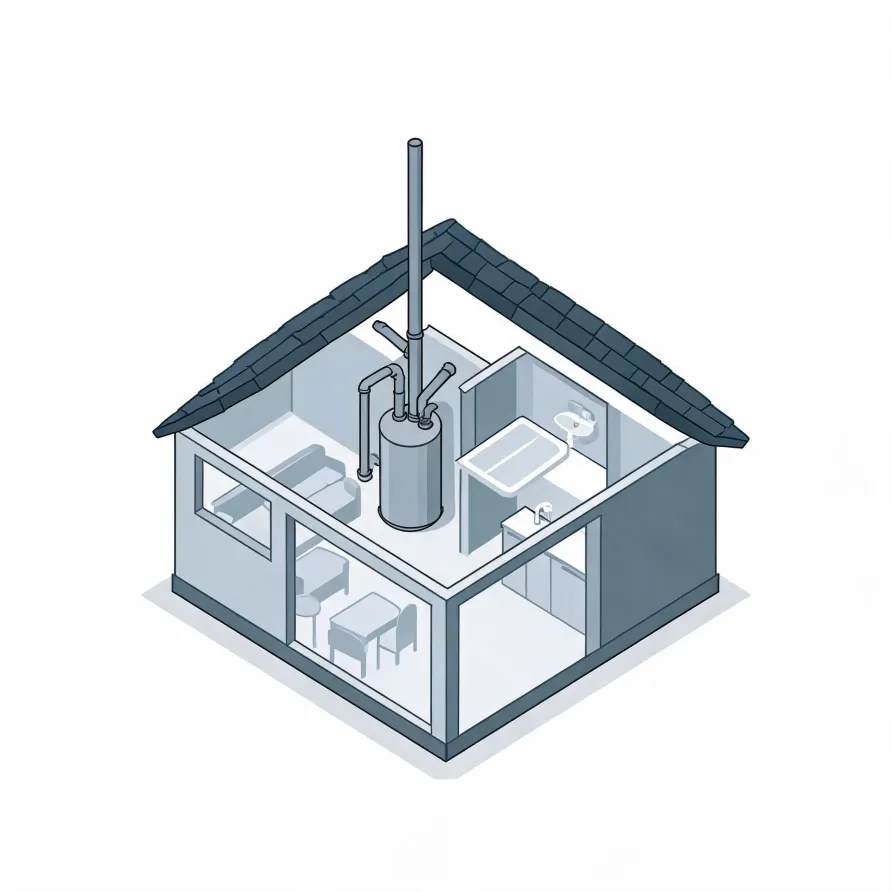
The tank is what most homeowners have seen, sitting in a basement, utility closet, or garage, and its job is to hold water at a set temperature until a tap opens. The burner assembly or heating element sits at the base or inside the tank and is where most heat-delivery failures begin. The thermostat, mounted on the tank's exterior or submerged inside it, tells that burner when to fire.
The pressure relief valve, fitted to the side of the tank, is a safety device that opens if pressure or temperature climbs past a safe point. The dip tube runs down into the tank to deliver cold water to the bottom, and the anode rod hangs inside to slow corrosion. A contractor working through a repair will move between these pieces systematically, since a symptom at one often traces back to another.
The drawing shows a typical water heater layout, and a licensed contractor determines which parts apply to the specific unit and setup in your home.
Get matched in Marathon CountyMarathon County, Wisconsin, by the numbers
174 severe weather events were recorded in Marathon County, Wisconsin between 2015 and 2024.
NOAA National Centers for Environmental Information, Storm Events Database, bulk CSV export, events 2015-01-01 through 2024-12-31.Half the homes in Marathon County, Wisconsin were built in 1978 or earlier (2020-2024 ACS 5-year).
U.S. Census Bureau, 2020-2024 American Community Survey 5-Year EstimatesMarathon County, Wisconsin holds 60,910 housing units (2020-2024 ACS 5-year).
U.S. Census Bureau, 2020-2024 American Community Survey 5-Year EstimatesOwners occupy 73.3% of the occupied homes in Marathon County, Wisconsin (2020-2024 ACS 5-year).
U.S. Census Bureau, 2020-2024 American Community Survey 5-Year EstimatesCodes & Standards Covering Water Heater Repair in Marathon County, Wisconsin2 sourced rules and standards
Licensing Rules for HVAC Repair in Marathon County, Wisconsin
A Wisconsin business that employs a certified HVAC qualifier is a certified HVAC business, and no city or county may require it to hold a local certification or licence on top of that.
Wisconsin requires a state HVAC contractor registration: no person or business may install or service heating, ventilating or air conditioning equipment, or offer to, without one.
Severe Weather Events in Marathon County, Year by Year
Extreme weather puts real stress on water heaters, pushing them to run harder and fail sooner than they would in mild conditions. How much of that pressure a unit faces depends on where it sits, which makes local weather history a practical part of understanding repair demand in Marathon County.
174 severe weather events, 2015–2024. Source: NOAA National Centers for Environmental Information, Storm Events Database.